
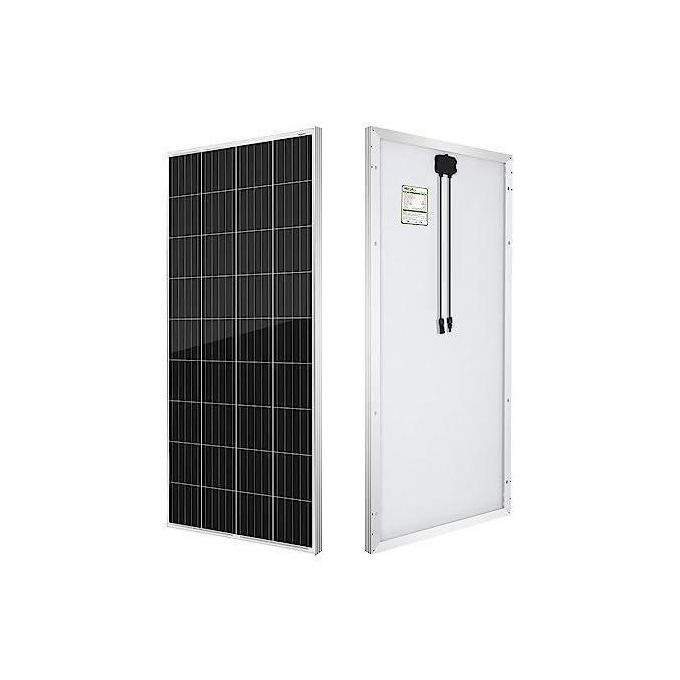
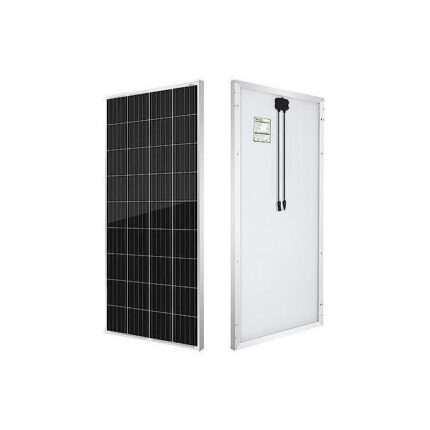
250W (Watt) Solar Panel
KSh11,000.00
| Electrical Parameter | Typical Value Range |
| Peak Power Output ($P_{max}$) | 250 Watts (Wp) |
| Voltage at Max Power ($V_{mp}$) | ~30V to 31.5V |
| Current at Max Power ($I_{mp}$) | ~8.0A to 8.4A |
| Open Circuit Voltage ($V_{oc}$) | ~37V to 38.5V |
| Short Circuit Current ($I_{sc}$) | ~8.6A to 9.4A |
| Module Efficiency | 15.3% to 18% |
| Maximum System Voltage | 1000V DC |
A 250W (Watt) Solar Panel is a highly popular mid-sized photovoltaic (PV) panel. While it used to be the baseline standard for residential rooftops, it is now primarily used for medium-scale off-grid installations, cabins, RVs, marine boats, and solar-powered water pumping systems.
📋 Typical Technical Specifications (Standard 60-Cell Config)
While minor differences exist between manufacturers, a standard 250W crystalline solar panel conforms to these Standard Test Conditions (STC):
| Electrical Parameter | Typical Value Range |
| Peak Power Output ($P_{max}$) | 250 Watts (Wp) |
| Voltage at Max Power ($V_{mp}$) | ~30V to 31.5V |
| Current at Max Power ($I_{mp}$) | ~8.0A to 8.4A |
| Open Circuit Voltage ($V_{oc}$) | ~37V to 38.5V |
| Short Circuit Current ($I_{sc}$) | ~8.6A to 9.4A |
| Module Efficiency | 15.3% to 18% |
| Maximum System Voltage | 1000V DC |
Physical & Mechanical Data
-
Cell Array Configuration: 60 Cells ($6 \times 10$ layout connected in series)
-
Average Dimensions: Approx. $1640 \times 992 \times 35\text{ mm}$ ($64.5 \times 39 \times 1.4\text{ inches}$)
-
Average Weight: 17 kg to 20 kg (37 to 44 lbs)
-
Front Glass: 3.2mm high-transmission, low-iron tempered glass
-
Frame Casing: Anodized aluminum alloy
-
Terminal Interface: Weatherproof IP65/IP67 junction box containing 3 bypass diodes, terminated with standard MC4 connectors on roughly 900mm output cables.
🔬 Monocrystalline vs. Polycrystalline 250W Panels
You will find 250W panels across two primary styles:
-
Monocrystalline (Black Cells): Cut from single, high-purity silicon crystals. They feature rounded cell corners and perform slightly better in low-light environments and tight footprints due to higher space efficiency.
-
Polycrystalline (Blue Cells): Melted from fragmented raw silicon blocks. Easily recognized by their speckled blue hue and perfectly square borders. They are traditionally cheaper to manufacture but require a slightly larger physical surface area to generate the exact same 250W output.
⚡ What Can a Single 250W Solar Panel Power?
On average, assuming a modest 4 to 5 hours of peak direct sunlight per day, a single 250W panel will produce roughly 1,000Wh to 1,250Wh (1.0 to 1.25 kWh) of raw energy daily.
This daily budget is ideal for running:
-
A small DC energy-efficient refrigerator or cooler.
-
Small agricultural DC submersible water pumps.
-
Multiple LED indoor lights, router networking boxes, and phone/laptop charging stations.
-
Basic security perimeter setups (CCTV cameras and floodlights).
System Component Tip: Because these panels typically output around 30V ($V_{mp}$), they cannot be wired directly into a standard 12V battery without damage or massive energy loss. You must run the panel line through an MPPT (Maximum Power Point Tracking) Charge Controller to safely down-convert the 30V panel input into a stable charging current for 12V or 24V battery banks.
Reviews
There are no reviews yet.